
The goal at Woodburners is to provide you with a fireplace that will best suit your needs. We work with numerous suppliers, offering a wide range of models to give you as many options as possible. Our years of experience and listening to customer feedback allow us to recommend the specific manufacturer, model and options that will work best for you.
Before you commit to a specific manufacturer and model, have a site evaluation conducted. A site evaluation will identify any design limitations that may make certain models unsuitable. Understanding all aspects of the proposed location enables making the best recommendation. This process is also useful for developing a preliminary budget that accounts for as many aspects of the installation as possible.
Wood Fireplace Types
Over the years, there has been a steady progression in how fireplaces have been constructed. Over time, masonry fireplaces have generally been replaced by manufactured ones, as they cost considerably less. After some time, manufacturers began producing models that more closely resembled an airtight stove in operation. As such, there are two general categories of fireplaces. Decorative fireplaces, including masonry and manufactured decorative models, are less efficient and generally do not produce significant heat. Decorative models alsohave less-controlled combustion, and most of the air rising up the flue is replaced by unheated air entering the building elsewhere. The primary heat produced by decorative fireplaces is radiant heat.
In contrast, modern manufactured models have sealed doors and controlled combustion. Air drawn into the firebox comes from outside the building envelope, so no cold air enters the house. As they are designed with a gasketed door and air controls, combustion is more regulated. House air is circulated around the firebox by convection or by fans, increasing the heat output. As a result, they are much more efficient and consume far less wood. Additionally, modern appliances with controlled combustion produce far less pollution.
Decorative Fireplace
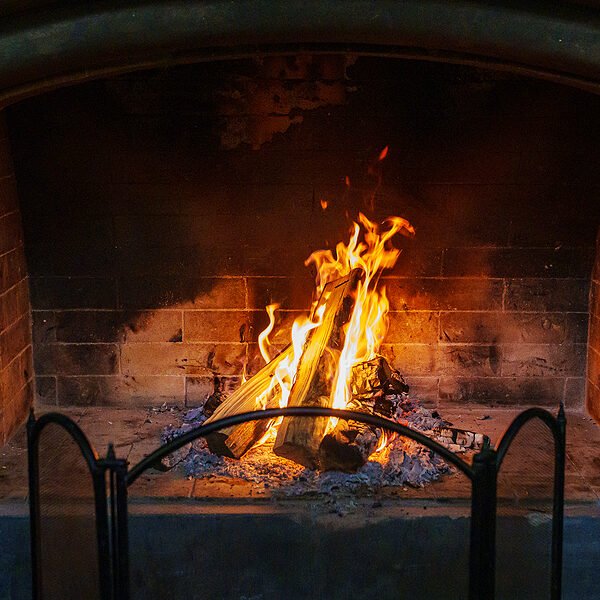
Traditional Masonry
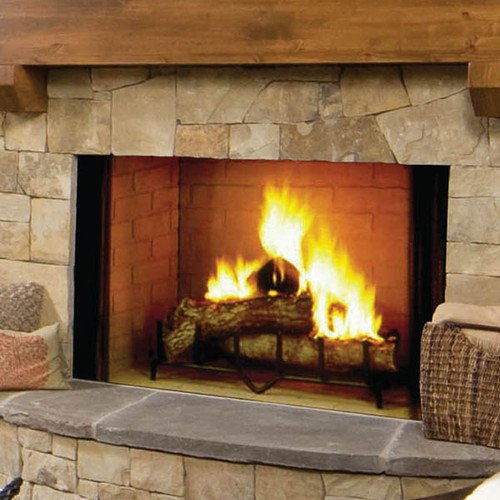
Biltmore Manufactured Decorative
Manufactured “Sealed” Fireplaces
Since the introduction of factory-built units, there has been a steady progression in their design. One of the earliest models was the B.I.S. (Built-In Stove) manufactured by Security.
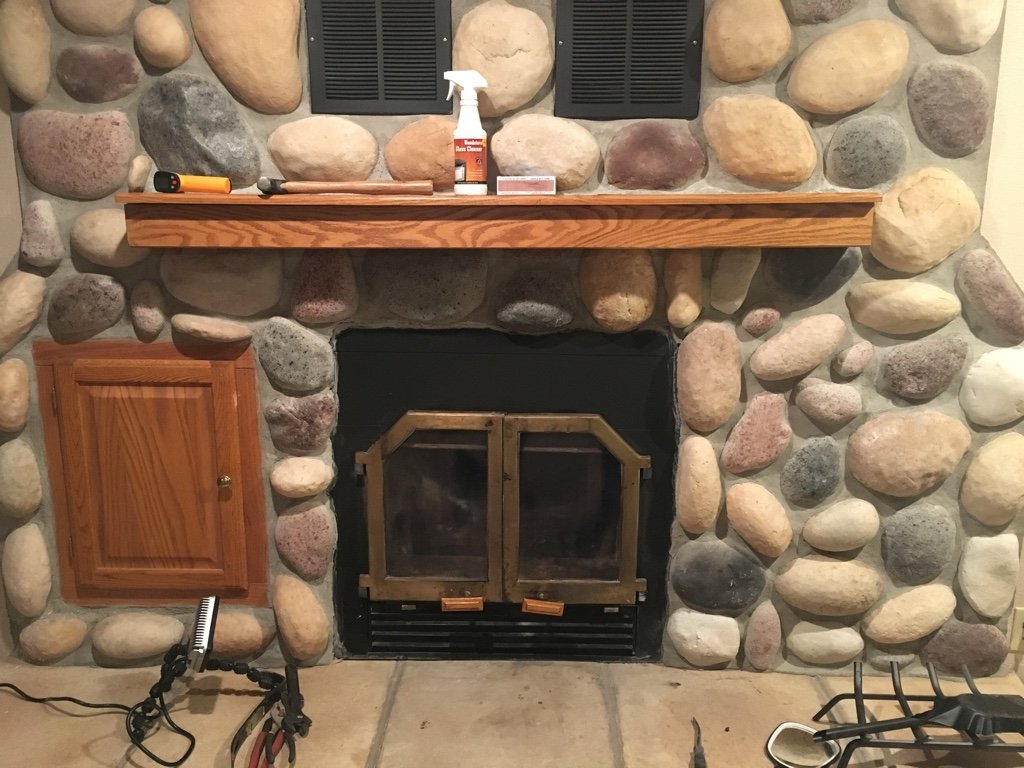
Security BIS Models had a sealed door and “gravity” air vents and fan
These fireplaces were one of the first to feature a gasketed door, an upper heat baffle, air-combustion controls, and a means of circulating air around the firebox to produce more heat.
An increased focus on pollution control and energy efficiency has led manufacturers to continue refining the design of modern stoves to make them more efficient heat generators and lower-emission. These refinements include refractory and insulating materials within the firebox and above the fire. This increases the fire’s internal temperature, resulting in more complete combustion. Additionally, more refined door gaskets and combustion controls, along with secondary combustion air and catalytic combustors, have greatly reduced the emissions of these appliances. Modern wood fireplaces must be ULC S627 Certified and meet the emissions standards established by E.P.A. 2020 or CSA B415.1-10
Modern EPA Certified Wood Fireplaces
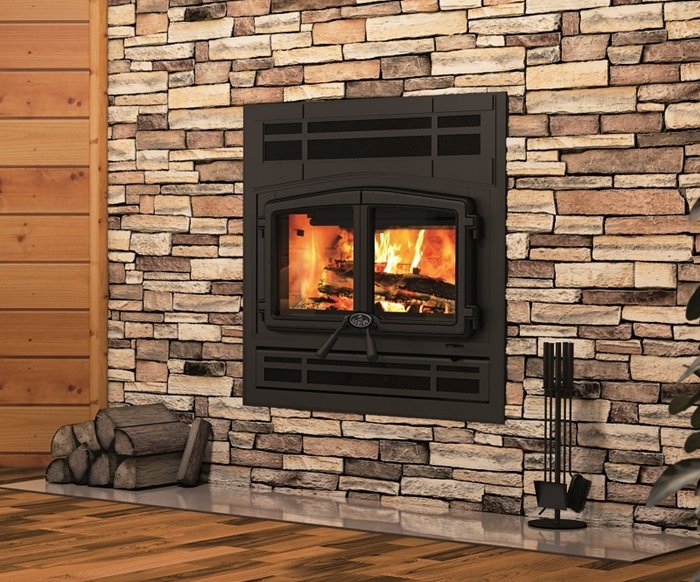
Osburn Stratford Fireplaces
Proper Stove Sizing and Heat Management
The heat output of all fireplaces is typically related to the firebox volume. Different wood species might yield higher heating values, but the most important consideration is firebox volume. As space heaters, wood fireplaces should be sized to heat the room they are located in. Having a large fireplace in a small room may result in the room becoming too warm for comfort, or meaning fires within it are too small for efficient combustion. Large fireplaces may also require a chimney with a flue diameter that is too large for installation within common joist and rafter spacings.
Operating wood fireplaces in the same room as the heating system thermostat may cause parts of the house to cool, as the furnace will not turn on.
A provision for transferring heat throughout the entire building may be warranted in these cases. Some manufacturers offer thermostatically controlled systems that can transfer heat between rooms and between different levels of the house with fans and ducting.