Choosing the Right Wood Stove
The goal at Woodburners is to provide you with a wood stove that will best suit your needs. We work with numerous suppliers, offering a wide range of models to give you as many options as possible. Our years of experience and listening to customer feedback allow us to recommend the specific stove and model that will work best for you.
Commit to a specific stove manufacturer and model after having a site evaluation conducted. A site evaluation will identify any design limitations that may make certain models unsuitable, and fully understand all aspects of the proposed stove location, enabling the best recommendation. This process is also useful for developing a preliminary budget that accounts for as many aspects of the installation as possible.
Wood Stove Types
There are two general categories of Wood Stoves. Radiant stoves (think old-school pot-belly stoves) and convective stoves. Radiant stoves generally do not have shielding around the firebox. As the heat radiates in all directions from the stove, the clearances to combustibles are generally greater.
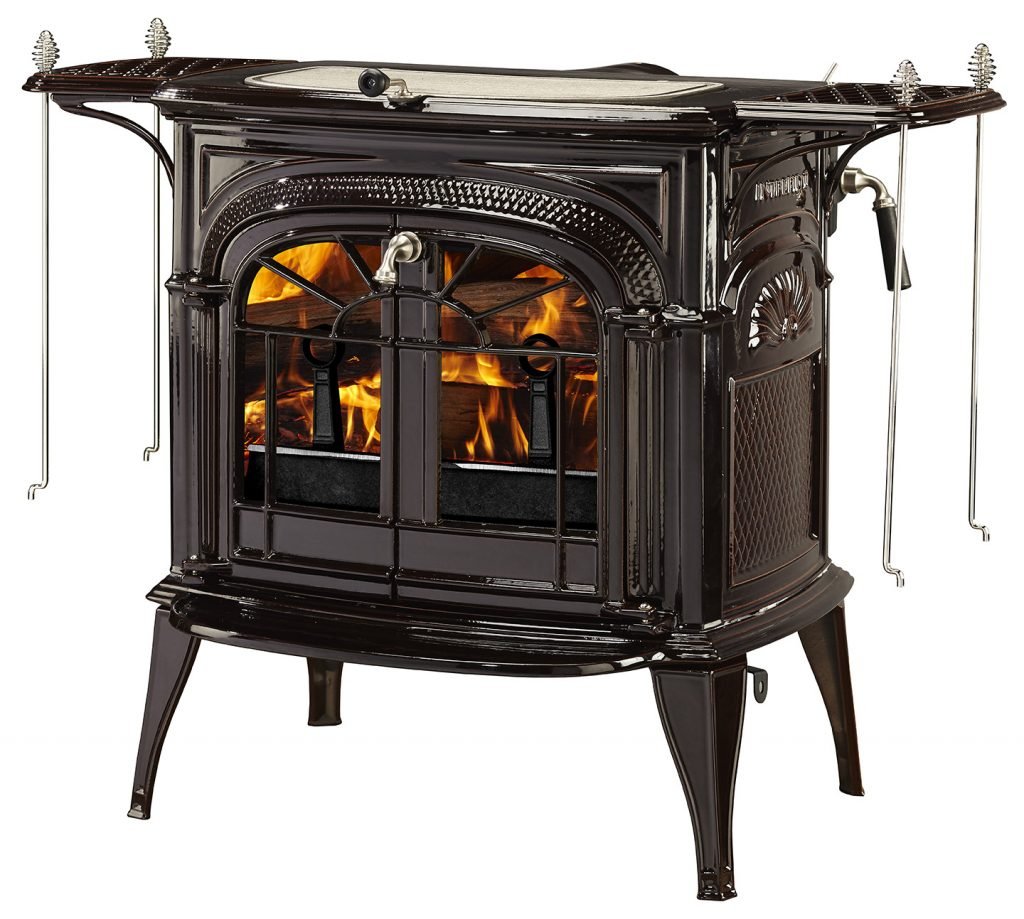
Vermont Castings Intrepid II Radiant Stove Flexburn (Catalytic)
Convective stoves incorporate shielding into their design. The shielding intercepts the heat radiating off the stove. Air travelling between the firebox and the shielding transfers heat by convection. The heat is transferred to the air travelling between the firebox and the shielding. The rate of heat transfer can be increased by fans attached to convective stoves, but they do not increase heat output. Convective stoves typically require less distance to combustibles. For all stove types, the typical ceiling requirement is 84 inches.
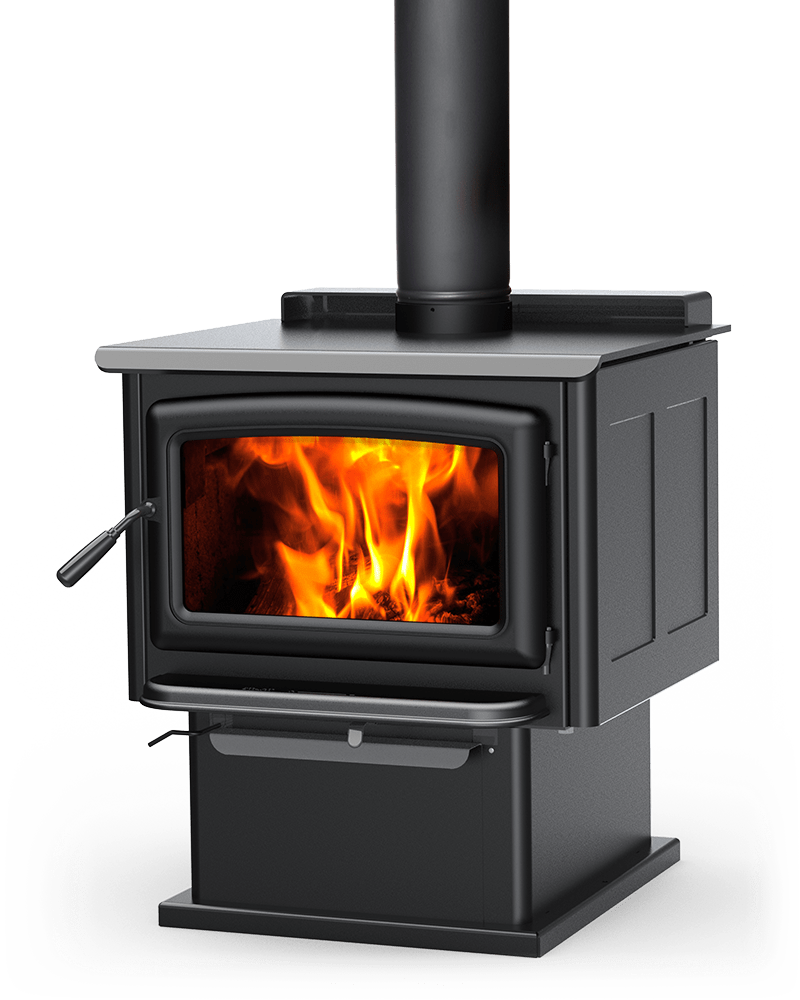
Radiant stoves are best suited to areas in the center of the room where they are located and are typically not suitable for corner and alcove installations. Convective stoves are typically more suitable for corner installations and alcoves.
Combustion Type
Modern wood stoves must meet the emissions standards established by E.P.A. 2020 or CSA B415.1-10 standards for sale and installation in Canada. It is to be expected that emission standards will become more important in the future. Modern stoves are constructed with gasketed doors and air-control mechanisms to regulate combustion. They also incorporate refractory bricks, insulation, baffles, and secondary combustion air to increase efficiency and reduce stove emissions. To further reduce emissions, most manufacturers have introduced models that also incorporate catalytic combustor elements. The available stoves can be categorized as catalytic or non-catalytic. While both require adjustments during operation, catalytic stoves are designed to operate within a temperature range and require additional monitoring.
Proper Stove Sizing
The heat output of all stoves is typically related to the firebox volume. Different wood species might yield higher heating values, but the most important consideration is firebox volume. As space heaters, wood stoves should be sized to heat the room they are located in. Having a large stove in a small room may result in the room becoming too warm for comfort, or meaning fires within it are too small for efficient combustion. Large stoves may also require a chimney with a flue diameter that is too large for installation within common joist and rafter spacings.
Operating wood stoves at the same level as the heating system thermostat may cause parts of the house to cool, as the furnace will not turn on.
A provision for transferring heat throughout the entire building may be warranted in some cases. In situations where the stove is intended to be the primary means of heating the house, the size, location and means of circulating air within the house become more important. In some cases, wood-burning furnaces may be the best option.
Stove Manufacturers and Models
True North Stoves
Pacific Energy
Osburn
Supreme
Jotul
Ironstrike
Regency